
User Feedback for Startups: The Secret to Improving Retention

In the fast-paced Nigerian tech ecosystem, getting a user to download your app is only the beginning of the journey. The real battle and where most businesses fail is keeping them. Retention is the silent engine of sustainable growth, yet many founders struggle with high churn rates shortly after launch. The secret weapon to solving this isn’t a bigger marketing budget; it’s high-quality, actionable user feedback for startups.
When you truly understand why a user leaves, you gain the strategic power to make them stay. By consistently collecting and analyzing user feedback for startups, you can identify hidden friction points, polish your user experience (UX), and build a product that Nigerians actually want to keep on their home screens. Platforms like OpinionPadi make this process seamless by connecting you with verified local users who provide the raw, honest insights you need to survive.
1. Why User Feedback for Startups is the Key to Retention
Feedback is far more than just a list of complaints; it is a strategic roadmap for your product’s evolution. For an early-stage company, every single comment is a vital data point that can prevent a user from hitting “uninstall.”
-
It Pinpoints Friction: Developers often become “blind” to their own products. Users, however, will quickly highlight confusing navigation, slow load times, or bugs that interrupt their flow.
-
It Validates Your Product Vision: Before spending millions of Naira on a new feature, user feedback for startups tells you if your audience actually needs it. This prevents “feature creep” and wasted resources.
-
It Predicts and Prevents Churn: If multiple users flag the same frustration, you are looking at a “churn trigger.” Fixing it immediately saves hundreds of future customers.
-
It Builds Emotional Loyalty: Nigerian consumers appreciate being heard. When a user sees their suggestion implemented in the next update, they stop being just a “user” and start being a brand advocate.
Example: A Nigerian fintech startup noticed a massive drop-off during the KYC (Know Your Customer) stage. Through OpinionPadi, they gathered user feedback for startups and discovered the document upload button was confusing on older Android phones. By fixing this one UI element, their successful onboarding rate jumped by 40%.
2. Proven Methods to Collect Effective Insights
To get the most out of user feedback for startups, you must go beyond the “contact us” form. You need to be proactive and intentional.
-
Segmented In-App Surveys: Don’t blast the same questions to everyone. Ask a new user about their first impression of the onboarding process, while asking a 6-month veteran about their favorite advanced features.
-
Focus Groups and User Testing: Watching a real person in Lagos or Port Harcourt navigate your app in real-time is eye-opening. You’ll see exactly where they hesitate or get frustrated.
-
Exit Surveys (The Goldmine): When a user closes an account or stops using the service, ask them why. This is the most honest user feedback for startups you will ever receive, and it is the key to stopping the “leaking bucket” of churn.
-
Community Listening: Monitor social media and forums like Nairaland, but remember that these are often “noisy.” Supplement this with structured surveys on OpinionPadi for more reliable data.
3. How OpinionPadi Powers Product Growth
Many Nigerian founders struggle with “low-quality” feedback from friends or random social media comments. OpinionPadi solves this by providing structured, verified user feedback for startups.
-
Verified Participants: We eliminate the risk of bots or “professional survey takers.” You get responses from real Nigerians with verified identities.
-
Iterative Testing: Startups move fast. You can test a new prototype on Monday, get user feedback for startups by Wednesday, and deploy a fix by Friday.
-
Hyper-Local Targeting: If your startup targets female entrepreneurs in the North, or students in the Southwest, we find that exact audience for you. General feedback is good, but targeted feedback is transformative

Startup team analyzing Nigerian user feedback on OpinionPadi.
4. Turning Feedback Into a Long-Term Retention Strategy
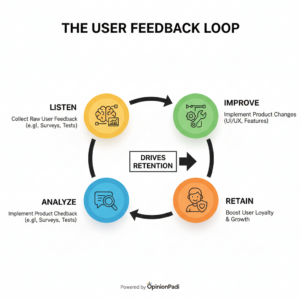
Collecting data is only the first half of the equation. The second half is execution. Here is how to turn user feedback for startups into a higher retention rate:
-
Prioritize by Impact: You can’t fix everything at once. Use a matrix to rank issues: Fix the “deal-breakers” (like payment failures or login loops) before you move on to aesthetic changes like button colors.
-
Close the Communication Loop: Don’t just fix the problem, tell your users you fixed it! Send an email or push notification saying, “We heard you! We’ve simplified the bank transfer process based on your feedback.” This makes users feel valued.
-
Measure Success Metrics: Always track your retention numbers before and after a change. If your churn rate drops after implementing user feedback for startups, you know your strategy is working.

FAQ Section
Q: How often should I collect user feedback for startups?
A: Feedback should be a continuous cycle. We recommend running a deep-dive survey every quarter and using “micro-surveys” (one or two questions) every month to stay in touch with user sentiment.
Q: Can I use feedback to win back lost users?
A: Absolutely. If you have a list of users who churned due to a specific missing feature, reaching out to tell them that feature is now live, based on their request is a highly effective “win-back” strategy.
Q: How many responses do I need for reliable data?
A: For most Nigerian startups, even 30–50 high-quality responses from a targeted group on OpinionPadi can reveal the vast majority of your product’s usability issues. Quality always beats quantity.
Q: Is user feedback for startups expensive for small teams?
A: It is far cheaper than the cost of acquiring new users only to have them leave. Investing in feedback early saves you from the “hidden cost” of high churn.
Related Posts

The Completion Secret: How to Nigerians Actually Finish
If you want to learn how to design surveys Nigerians actually finish, you first have to understand the frustration of […]

Decoding the “Stress Factor”: What Nigerian Users Mean When They Sa y an App Is Stressful
If you’ve ever sat through a user testing session in Lagos or Abuja, you’ve likely heard it. A user frowns […]

The Incentive Paradox: How Incentive Size Changes Feedback Quality
In the world of Nigerian side hustles, the rule is usually “the higher the pay, the better the job.” But […]