Early-stage founders in Nigeria often celebrate the wrong milestones. It is easy to get excited when you see 10,000 app downloads in the first month or a surge in website page views after a social media shoutout. However, these are often “vanity metrics”, numbers that look impressive on a pitch deck but don’t actually tell you if your business is healthy.
The reality is that downloads don’t pay the bills; active, satisfied users do. To build a sustainable company, you must look past the surface and focus on User Feedback. Platforms like OpinionPadi are designed to help Nigerian startups cut through the noise of misleading numbers and collect the actionable insights that truly drive product-market fit.
1. Vanity Metrics vs. Real User Feedback
Understanding the difference between these two categories is the first step toward better decision-making.
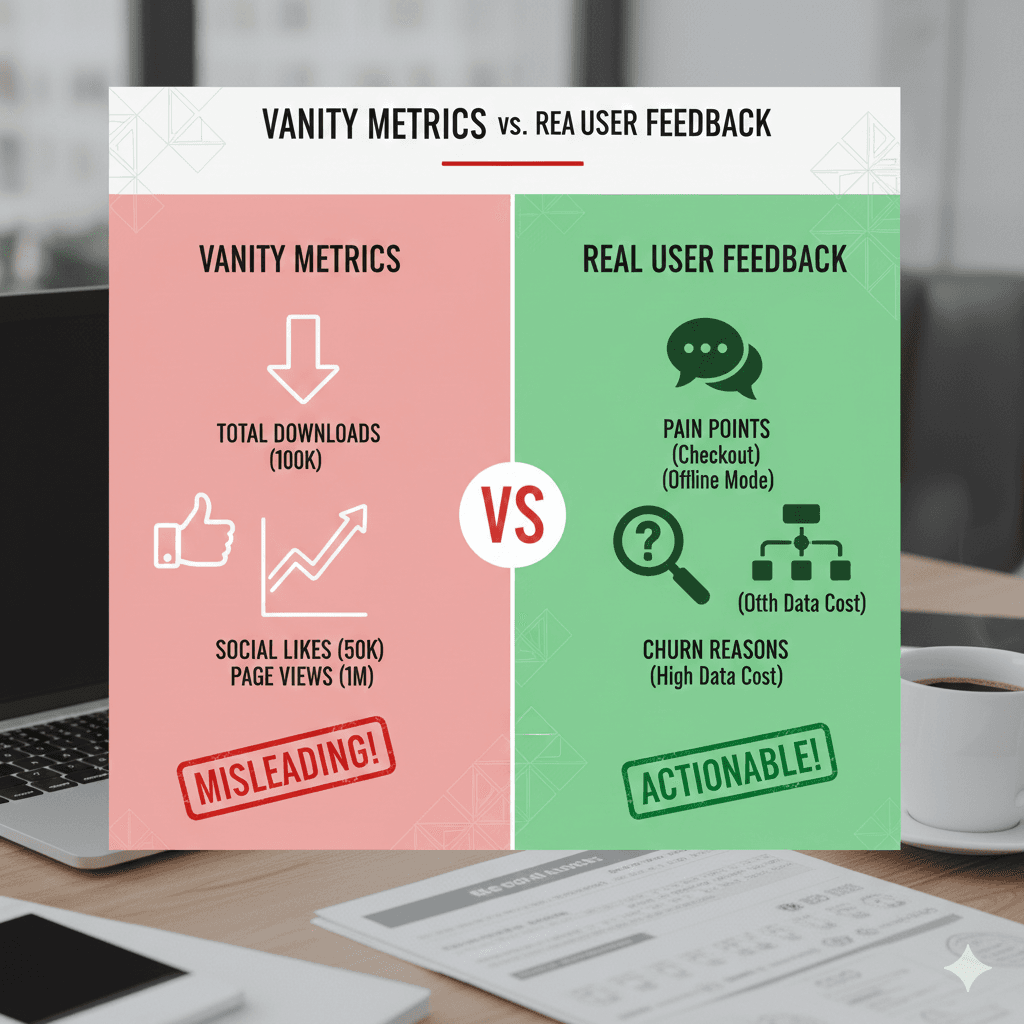
Vanity Metrics are numbers that make you feel good but don’t provide a clear path for action. They are often “cumulative” numbers that only go up, regardless of whether the product is actually working.
Total signups or app installs
Social media likes, shares, and followers
Raw pageviews or session counts
Real User Feedback, on the other hand, provides the “why” behind the numbers. It gives you a roadmap for what to build next and what to fix immediately.
Specific frustrations with the payment gateway
Reasons why a user stopped using the app after three days (churn analysis)
Preferences between two different UX designs
Suggestions for new features that solve daily Nigerian problems
2. How Vanity Metrics Mislead Nigerian Founders
In a market as competitive as Nigeria, relying solely on vanity metrics can be dangerous. Founders who don’t prioritize User Feedback often fall into these traps:
The Engagement Illusion: Assuming that 5,000 downloads mean you have 5,000 customers. In reality, 80% of those users might have deleted the app because it was too heavy for their data plan.
The Feature Factory: Building more and more features because “more is better,” without realizing that users find the core product confusing.
Wasted Marketing Spend: Pouring money into ads to get more signups, while the “leaky bucket” of poor user experience remains unfixed.
Example: A Nigerian e-commerce startup celebrated 20,000 app installs. However, their revenue remained flat. When they used OpinionPadito collect direct User Feedback, they discovered that while people were downloading the app, they were abandoning it at the checkout because the delivery fee calculation was hidden until the very last step. By fixing this transparency issue, their conversion rate doubled within weeks.
Graph illustrating the gap between high app downloads and low actual user engagement .
3. OpinionPadi – Turning Numbers into Narratives
OpinionPadihelps Nigerian startups move from “counting” to “consulting” their audience. Instead of just seeing a percentage, you hear the voice of the customer.
How OpinionPadi facilitates real User Feedback:
Qualitative Depth: Move beyond “Yes/No” answers. Ask users to explain in their own words what they value most about your service.
UX Pain Point Identification: Use targeted surveys to pinpoint exactly where users get stuck.
Regional Segmentation: In Nigeria, a user in Lagos might have different needs than a user in Kano. OpinionPadi allows you to segment feedback by region, age, or device type.
Rapid Iteration: Get feedback in 24-48 hours, allowing your development team to fix bugs and update features before your reputation is affected.
Case Study: A Nigerian food delivery startup planned to launch a luxury loyalty program. Before spending millions on development, they ran a survey on OpinionPadi. The User Feedback was clear: users didn’t want loyalty points; they wanted a “lower data” version of the app and more accurate delivery tracking. The startup saved millions by building what users actually asked for.
Ready to stop chasing vanity metrics and start chasing growth? Follow these steps:
Define “Success” Metrics: Instead of “Total Downloads,” track “7-Day Retention.” This tells you if the User Feedback you are receiving is leading to a better experience.
Ask “Why” Three Times: When a user stops using your service, don’t just mark them as “inactive.” Use a survey to ask why they left, what they used instead, and what would bring them back.
Incentivize Honesty: Nigerians are busy. Use a platform like OpinionPadi that rewards users for their time, ensuring you get thoughtful, high-quality responses rather than rushed clicks.
Share Feedback with the Whole Team: Don’t keep the insights in the marketing department. Make sure your developers and designers read the raw User Feedback to understand the human side of the code they write.
Nigerian startup team in a collaborative meeting analyzing real user feedback .
A: No. They are good for PR and showing “reach,” but they are useless for making internal product decisions. Always pair them with User Feedback.
Q: How often should I collect feedback from my users?
A: It should be a continuous loop. At a minimum, you should run a major survey once a quarter and smaller “pulse” surveys after every major feature update.
Q: Can OpinionPadi help me find my target audience?
A: Yes. OpinionPadi has a verified pool of Nigerian users that you can filter by age, location, income level, and interest to ensure you are getting feedback from the right people.
Q: What is the best way to ask for feedback without being annoying?
A: Keep surveys short (3-5 minutes) and clearly explain how the user’s input will make the product better for them. Using a rewarded platform like OpinionPadi also makes the process feel like a fair exchange of value.
We use essential cookies to keep OpinionPadi secure. With your permission, we'll also use cookies to remember your preferences and improve advertising relevance through Google AdSense and other partners. You can manage your choices at any time.