
The Incentive Paradox: How Incentive Size Changes Feedback Quality


In the world of Nigerian side hustles, the rule is usually “the higher the pay, the better the job.” But in market research, that logic can actually backfire. If you are a founder or a researcher, understanding how incentive size changes feedback quality is the difference between getting a roadmap for success and getting a pile of expensive lies.
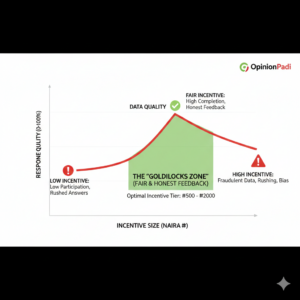
When a participant sees a massive reward for a short task, their brain often switches from “Helper Mode” to “Hunter Mode.” Instead of thinking about the questions, they are thinking about the payout. This creates a “Data Distortion” that can lead brands to make million-naira mistakes.
1. The “Hunter Mode” Problem: Why More Isn’t Always Better
When we talk about how incentive size changes feedback quality, we have to look at the psychology of the “Rushed Response.”
-
The Gaming Effect: If a survey pays ₦5,000 for 5 minutes, you will attract “Professional Survey Takers” who use multiple phones or bots to finish as fast as possible.
-
The “Pleaser” Bias: High incentives can make participants feel they must give positive answers to “earn” the money, even if they actually disliked the product.
-
Low-Incentive Apathy: On the flip side, if the reward is too low (e.g., ₦50 for 30 minutes), users will click random buttons just to finish the “boring” task, or they will quit halfway.
2. Finding the “Goldilocks Zone” in Nigeria
To get the best data, the incentive must be “just right”, high enough to respect the user’s time and data costs, but not so high that it triggers greed.
In the Nigerian context, researchers must account for:
-
Data Costs: A survey with many videos requires a higher incentive to cover the user’s megabytes.
-
Time Value: A survey targeting doctors requires a higher incentive than one targeting students, because the doctor’s time is “more expensive.”
-
Economic Reality: In a high-inflation environment, ₦200 today doesn’t buy what it bought last year. Incentives must be updated to remain “fair” without becoming “extreme.”
3. How OpinionPadi Protects Data Integrity
At OpinionPadi, we are obsessed with the science of how incentive size changes feedback quality. We don’t just throw money at users; we engineer a fair exchange.
Our Quality Control Pillars:
-
Tiered Rewards: We calculate rewards based on the “Effort Score” of the survey. Complex tasks pay more, but never so much that they invite fraud.
-
Trap Questions: Our system uses “Attention Checks” to catch anyone who is rushing because of the incentive.
-
Speed Limits: If a user finishes a 10-minute survey in 2 minutes, our system flags the data as “low quality” and may withhold the incentive.
-
Community Education: we teach our Padis that honest, slow feedback leads to more high-paying surveys in the future, while rushing leads to fewer opportunities.

4. Checklist for Research Success
If you are designing a survey for the Nigerian market, use this checklist to ensure your incentive helps rather than hurts:
-
Calculate the “Data-to-Reward” Ratio: Does the payout cover the data needed to load the survey?
-
Benchmark Against the Market: What are other reputable platforms like OpinionPadi paying for similar tasks?
-
Use Quality-Based Bonuses: instead of one giant payout, offer a base reward + a bonus for “High-Quality Open-Ended Comments.”
-
Beta Test the Price: Run the survey for 10 people. If they all finish in record time with identical answers, your incentive is too high.

Conclusion: Fair Pay for Fair Play
Understanding how incentive size changes feedback quality is about respect. Respect for the researcher’s budget and respect for the participant’s time. When you find that balance, the data speaks the truth.
Need honest feedback from real Nigerians? Partner with OpinionPadi to access a community that values quality over quick cash!
FAQ Section
Q: Can I offer non-cash incentives like airtime?
A: Yes! In Nigeria, airtime is often seen as “digital currency” and works well for shorter surveys, whereas bank transfers are preferred for longer, more complex tasks.
Q: Does OpinionPadi help me set the right price for my survey?
A: Absolutely. We provide guidance to researchers to ensure their incentives are competitive for the Nigerian market without compromising data integrity.
Q: What happens to users who give bad data just for the money?
A: Our system reduces their “Trust Score.” If the score falls too low, they stop receiving premium surveys until they prove they can provide quality feedback again.
Suggested read: Product Validation in Nigeria: Why Surveys Alone Are Not Enough
Q: Why do some surveys pay more for the same length?
A: This usually means the target audience is very specific (e.g., “Business owners in the oil sector”) or the survey requires more mental effort, like recording a voice note.
Related Posts
How to Build Trust with Survey Respondents in Nigeria: 10 Practical Tips

In today’s data-driven world, surveys are one of the fastest ways for Nigerian brands to understand customer needs. Whether it’s […]

How UGC (User-Generated Content) Helped Nigerian Brands Grow: 2025 Case Studies
Marketing in 2025 is no longer a one-way street where brands talk and customers listen. Today, audiences want to participate, […]

Tools for Collecting Reliable User Feedback in Nigeria : 7 Top User Testing Feedback Nigeria Tools
Whether you’re building a mobile app, e-commerce website, or digital product, collecting user feedback is critical to success.But many Nigerian […]